
Good condition
Elevation: 91m
Parking: 37.2012°, -3.4477°
Ferrata: 37.1988°, -3.4476°




 Exposed
 Zipline
 Bridges
Characteristics
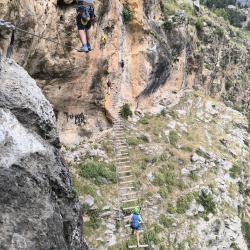
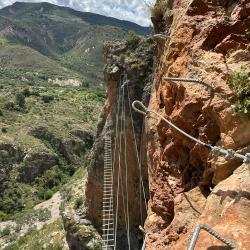
The entrance to the via ferrata is a Nepalese bridge about 50 meters long and steep. After a well-equipped vertical climb, we enter the much more aerial area of the Colmena Cave. We will find our first Tibetan bridge, about 30 meters high. At this point, we can descend an overhang to the K4 section or take the via ferrata escape route by ascending a K3 section.
After descending the overhang, we find a 33-meter zip line with an unusual, low, lateral exit—difficult for those taller than 1.8 meters. Using a double steel pulley and without taking momentum, it deposits us about two meters from the wall, which we will climb by hand.
We descend again and must cross a seesaw bridge with considerable movement between the crossbars. At the end of this bridge, we encounter a couple of steep overhangs that will take us to the previous fork, where we will ascend the K3 section to the exit of the via ferrata.
Arrival
Once in Quéntar, follow the signs on the GR-3201 road to the soccer field until you reach a metal gate. If it's not open, you can park your car a few meters beforehand and go through the gate on the side. Via ferrata information on Google Maps.
Approach
Next to the via ferrata sign, we'll see a path leading down, and in 5 minutes we'll be at the base of the Nepalese bridge.
Descent
Points of interest
As typical for the style in Spain/France the cable is only for security and should NOT be used for climbing, so of course also the difficulty level is based on that (different style like in the alps etc. where the cable has much more tension and counts as part of the ferrata)
(Multiple authors)


 © 2026 Ferrata Guide


